
In this guide 9 sections
Diamond blades and grinding wheels are made by combining an abrasive working section with a supporting body and a machine-compatible mounting interface. For many segmented blades, production includes powder preparation, segment pressing and sintering, body preparation, segment attachment and finishing. Grinding wheels follow routes appropriate to their metal or resin bond and body design.
For an overseas buyer, understanding this sequence makes a supplier discussion more useful. It helps explain why two tools with the same outside diameter can differ in application, mounting requirements and production cost.
The practical question is: Which manufacturing choices affect the job you need the tool to perform, and how will those choices be confirmed before shipment?
This guide follows three visible operations—segment pressing, blade-segment joining and hole machining—and connects them to the information needed when purchasing tools for ceramic tile, sintered stone and natural stone processing.
Start with the three parts of a diamond tool
A useful specification separates the working section, supporting body and mounting interface. Each serves a different purpose, so each needs its own description.
| Part | What it does | What the buyer should identify |
|---|---|---|
| Abrasive working section | Performs the cutting or grinding | Material application, bond system, working dimensions and required finish |
| Supporting body | Carries the working section and transmits machine forces | Body construction, relevant dimensions and condition |
| Mounting interface | Connects and locates the tool on the machine | Bore, mounting faces, hole pattern or other specified connection |
Compare the options Tap to expand
Abrasive working section
- What it does
- Performs the cutting or grinding
- What the buyer should identify
- Material application, bond system, working dimensions and required finish
Supporting body
- What it does
- Carries the working section and transmits machine forces
- What the buyer should identify
- Body construction, relevant dimensions and condition
Mounting interface
- What it does
- Connects and locates the tool on the machine
- What the buyer should identify
- Bore, mounting faces, hole pattern or other specified connection
In a segmented diamond blade, the outer segments contain diamond abrasive held in a metal bond. The steel core supports them. Norton’s guide to diamond-blade construction describes this distinction between the core and cutting section.
A grinding wheel may instead have a continuous abrasive ring, separated segments or a shaped working surface. Its specification must describe that geometry as well as the mounting arrangement. A photograph helps identify the product family; a drawing establishes the dimensions needed for an order.
Before discussing production methods, name the operation: straight cutting, miter preparation, squaring, edge refinement or profiling. “Diamond tool for stone” leaves too many manufacturing decisions unresolved.
Segment pressing: giving the working section its shape
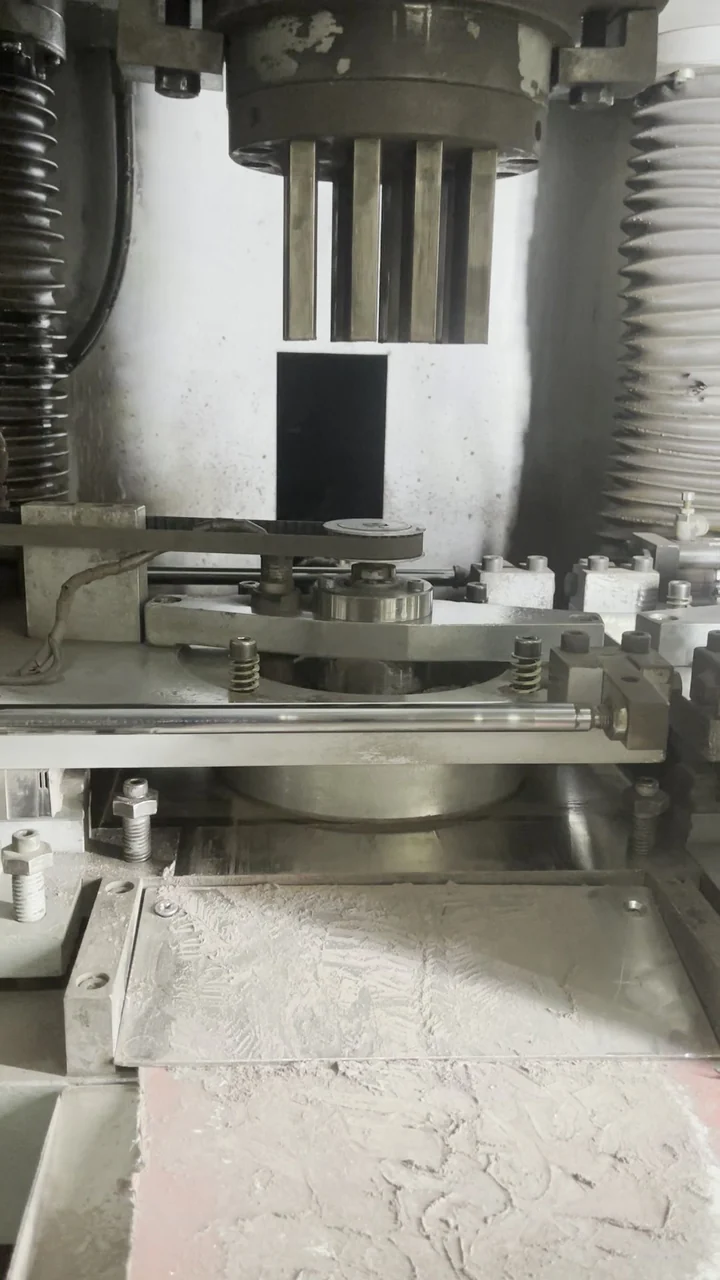
How pressing relates to sintering
For a common metal-bond segment route, diamond abrasive and metal powders are prepared as a mixture and formed into the required geometry. Pressing creates a compact; subsequent thermal processing consolidates the material. Cold pressing and hot pressing describe different process conditions, not two universal quality grades.
Published research on diamond-impregnated tool manufacture describes cold-compacted mixtures followed by sintering, including routes using heat and pressure together. The production route must suit the particular formulation and tool design.
The pressing-station photograph brings attention to geometry. Several shaped cavities sit beneath the tooling, illustrating why segment form is a defined production feature rather than a detail to settle after ordering.
What should be agreed before production?
Ask the supplier to identify the segment length, width or thickness, height and shape applicable to the quoted item. Also establish how the dimensions will be measured on the finished tool.
Segment height and segment thickness are different specifications. A taller working section does not automatically mean a better edge, and a thinner section does not automatically suit every machine. Discuss the combination against the material, workpiece thickness and required cut.
The bond specification also needs an application reference. It controls how the diamond-bearing matrix behaves in use; its suitability cannot be judged from the segment’s color. If a formulation code is proprietary, an agreed product code and application description can still give the buyer a stable purchasing reference.
Keep that reference on the sample request, quotation and repeat order. Asking for “the same blade as last time” is less reliable than identifying the approved item and any agreed revision.
Segment attachment: connecting the cutting section to the blade
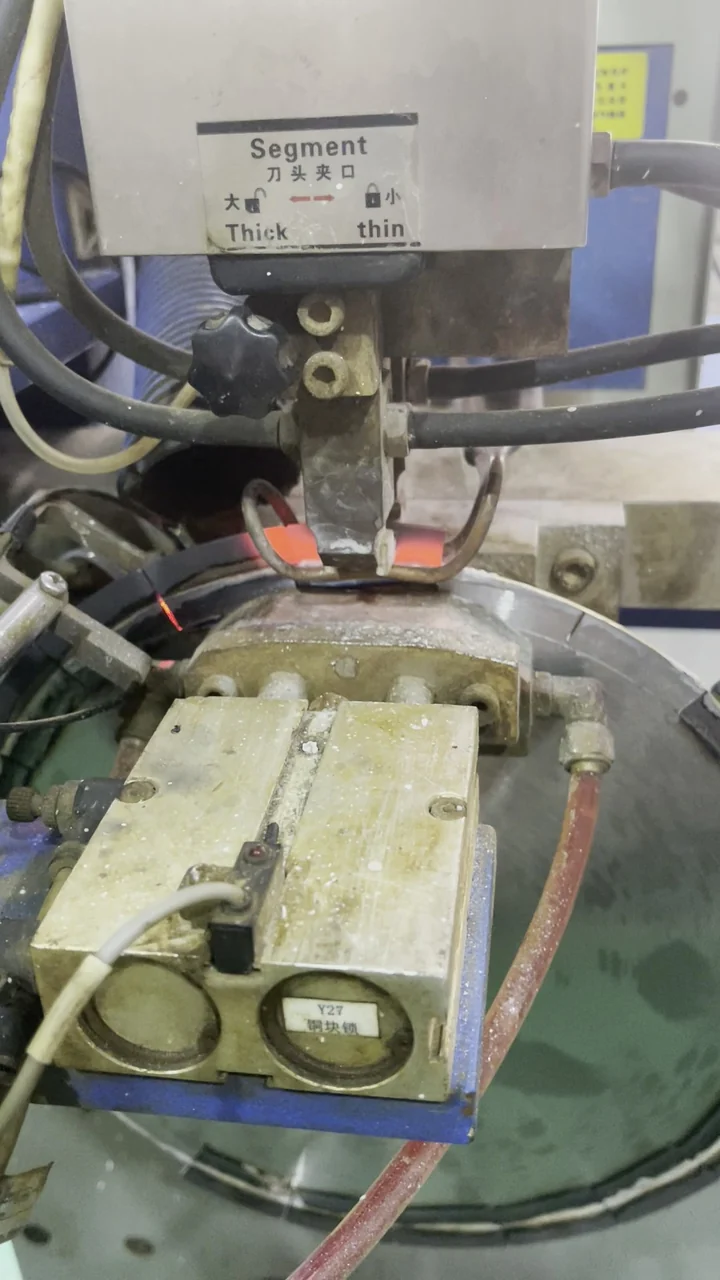
The joining-station close-up shows the blade body, segment holder and localized heating area together. For the buyer, this is a useful way to separate two questions: how the segment was manufactured, and how it is attached to the core.
These are distinct production decisions. A segment may be sintered before it reaches a joining station. Describing a blade as “sintered” therefore does not always explain its complete assembly route.
Brazing and laser welding are different processes
Induction brazing uses induction heating and a filler metal to form a joint without melting the two base components. Ambrell explains this mechanism in its induction-brazing guidance. Laser welding uses a different joining mechanism and should not be treated as another name for the same process.
In commercial product descriptions, “high-frequency welding” may refer to an induction-heated brazing operation. Ask the supplier to state the actual joining method for the item being quoted, particularly when comparing differently worded offers. Our hot-pressed versus HF-joined blade guide explains the terminology in more detail.
What belongs in the purchasing discussion?
Confirm the blade reference, segment arrangement, intended material and approved wet or dry operation. Then ask which inspections apply to the assembled blade, how acceptance is defined and how the results are associated with the order.
Segment-position checks and joint-integrity checks answer different questions. A consistent-looking rim is useful for visual review, while acceptance of the attachment requires the manufacturer’s appropriate inspection procedure. Any destructive testing must have an agreed sampling plan rather than an assumption that every delivered item undergoes it.
Do not derive operating permission from a process label. The exact tool’s instructions and rating, together with machine compatibility, determine its permitted use. A quotation should make that information easy to identify before the tool reaches production.
Machining the body and mounting features
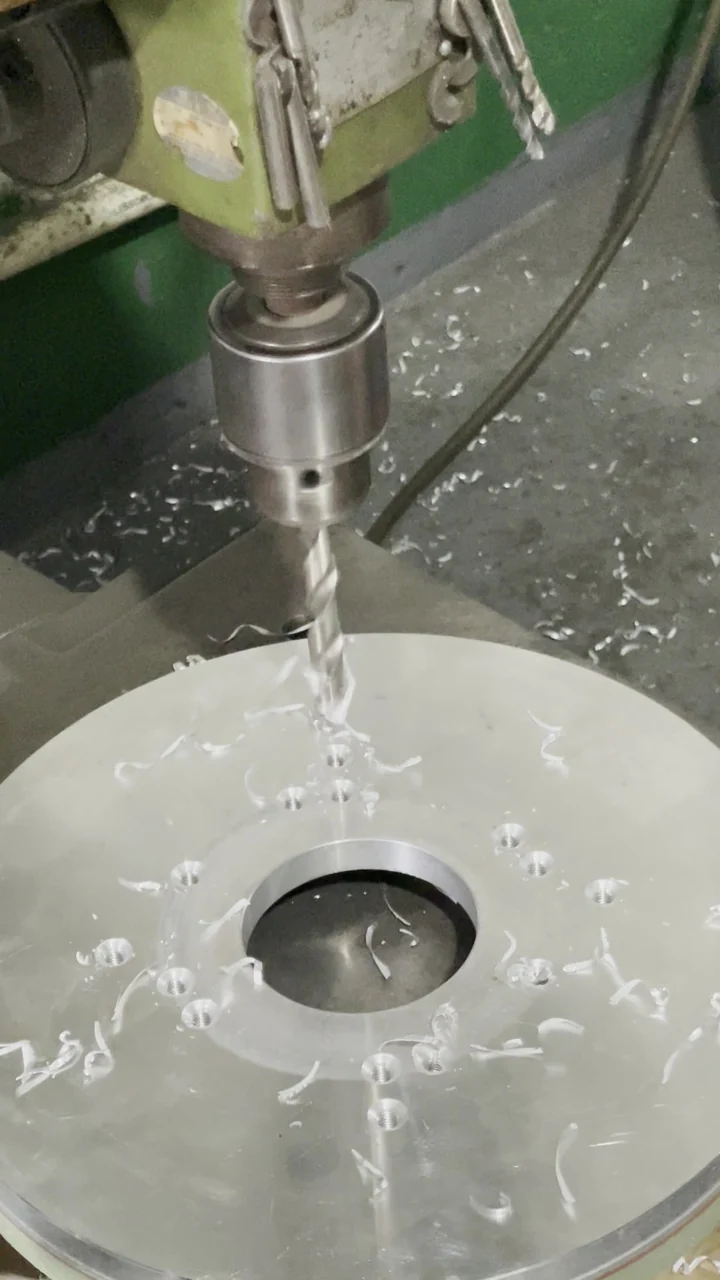
The body-machining photograph shows a large central bore and smaller holes in the surrounding metal. These features deserve a separate drawing review: matching the outside diameter alone does not establish that a tool will mount correctly.
For a wheel body, the interface may involve a locating bore, bolt pattern, recess, mounting face or other features. Identify their functions from the machine documentation and approved drawing. A visible hole is not automatically a mounting hole; some designs include other functional openings.
Specify the interface without guesswork
Where relevant, provide the bore diameter, hole count, pitch-circle diameter, hole size, thread specification and axial dimensions. A dimensioned drawing should also identify the reference face and orientation. State units explicitly, especially when communicating between metric and inch-based drawings.
If the existing tool is worn or damaged, do not use every measured surface as an unquestioned nominal dimension. Compare it with the machine documentation or ask for a drawing review. Photos taken from directly above and from the side help clarify the layout, but they cannot replace measurements.
Installation preparation should begin before the purchase order. Confirm available clearance, locating features and the approved operating speed against the machine and tool instructions. Resolve discrepancies with the supplier before dispatch; machining a delivered tool to make it fit should not become the default solution.
For saw blades, the same principle applies to the bore and flange arrangement. The machine-matching guide provides a more focused specification checklist.
Why grinding wheels need their own manufacturing specification
A grinding wheel is not simply a saw blade with a wider working edge. The contact surface and intended operation differ, and the body must position that surface correctly on the machine.
Published resin-wheel manufacturing methods describe forming abrasive-bearing resin mixtures and curing them, with different arrangements for connecting the working section to the inner body. Resin curing and metal-powder sintering are different material-processing steps. The relevant route depends on the wheel construction.
For a purchasing specification, separate preparation of the metal body from manufacture of the abrasive layer. Ask how the completed assembly is identified and checked, rather than assuming that a machined body establishes the quality of the finished wheel. This also helps clarify which details can be customized and which need a new technical review.
Metal and resin bonds are distinct abrasive-bond families. Norton’s bond-selection overview explains that different bond systems offer different characteristics. Selecting between them requires the operation and expected result, rather than a general ranking of one bond above another.
For a squaring or finishing wheel, describe the working width, profile, abrasive specification and position in the processing sequence. A replacement intended for an early removal stage may require a different configuration from one intended to refine the final edge.
The manufacturing brief should therefore identify both the physical wheel and its job in the line. LACH DIAMANT’s surface-grinding information likewise emphasizes matching wheel geometry, grain characteristics and bond to the workpiece and desired surface.
When reviewing resin-bond squaring wheels, include the material, existing station sequence and edge requirement. When reviewing HF ceramic saw blades, describe the cutting task and machine. This gives the supplier the right starting point for each product family.
Turn manufacturing stages into practical inspection points
Factory testing is most useful when the buyer and supplier agree what each check is intended to establish. Separate dimensional acceptance, assembly condition and application performance instead of treating “quality checked” as one complete answer.
| Stage or feature | Useful purchasing question | Record to request where applicable |
|---|---|---|
| Working-section design | Which dimensions and application reference define this item? | Approved specification or drawing |
| Segment attachment | How is the assembly checked against its acceptance criteria? | Relevant inspection method and results |
| Body and mounting interface | Will the tool locate and seat correctly on our machine? | Dimensional inspection against the agreed drawing |
| Finished-tool condition | Which geometry and condition checks are included? | Inspection checklist with identified limits |
| Application trial | Does the tool produce our required cut or edge? | Trial conditions, observations and acceptance decision |
| Shipment release | Does the shipment match the approved order? | Item references, quantities and packing records |
Compare the options Tap to expand
Working-section design
- Useful purchasing question
- Which dimensions and application reference define this item?
- Record to request where applicable
- Approved specification or drawing
Segment attachment
- Useful purchasing question
- How is the assembly checked against its acceptance criteria?
- Record to request where applicable
- Relevant inspection method and results
Body and mounting interface
- Useful purchasing question
- Will the tool locate and seat correctly on our machine?
- Record to request where applicable
- Dimensional inspection against the agreed drawing
Finished-tool condition
- Useful purchasing question
- Which geometry and condition checks are included?
- Record to request where applicable
- Inspection checklist with identified limits
Application trial
- Useful purchasing question
- Does the tool produce our required cut or edge?
- Record to request where applicable
- Trial conditions, observations and acceptance decision
Shipment release
- Useful purchasing question
- Does the shipment match the approved order?
- Record to request where applicable
- Item references, quantities and packing records
Agree the measurement conditions
If runout is part of the specification, ask where it is measured and how the tool is mounted during measurement. Radial runout and axial runout describe different deviations. An isolated number has limited meaning without the setup, units and acceptance limit.
Use the same discipline for working-section dimensions and mounting features. The inspection record should make clear which characteristic was checked, which reference was used and whether the result met the agreed requirement.
Keep factory inspection and application approval connected
A tool can meet its dimensional drawing while still needing an application trial on the buyer’s actual material. Conversely, an attractive sample edge does not settle mounting compatibility or shipment identification.
For the trial, record the tool reference, material, machine and relevant operating conditions. Evaluate the output that matters to the job: accepted edge condition, required dimensions, additional finishing or another agreed criterion. Avoid changing several variables at once when investigating a disappointing result.
Carry the approved specification into repeat orders
Once a sample or initial order is approved, keep the purchasing reference specific. Record the product code, drawing revision, application, working dimensions, interface and agreed operating mode. Include a retained sample or dated photographs when they help identify the configuration.
Request notification before a change affecting the approved specification is supplied. The important issue is whether the change could alter fit, application or the agreed acceptance result—not whether the product looks similar in a catalog photograph.
For international orders, shipment inspection should connect the physical goods to the paperwork. Check item references, quantities, labels and the agreed packing arrangement. Where several specifications share a similar appearance, make their package identification clear enough for the receiving team to separate them without trial fitting.
Packing requirements should address the actual product and transport arrangement. Protect working edges and mounting faces from contact damage, and agree how different items are separated and identified. Discuss the shipping mode and handling requirements when confirming packing, rather than after the goods are ready.
A distributor ordering several variants should keep each configuration as a separate line item. This helps sales, warehouse and technical staff identify which version a customer received when discussing replacement orders or application questions.
Frequently asked questions
Are diamond tools made with real diamonds?
Yes. Many industrial diamond blades use manufactured diamond abrasive. “Synthetic” describes how the diamond is produced; it does not mean the abrasive is simply imitation diamond. The tool’s performance also depends on the bond, geometry and application, so the word “diamond” alone is not a complete quality specification.
What is the difference between pressing and sintering?
Pressing forms powder into a compact of the intended shape. Sintering uses thermal processing to consolidate the material. Some production routes combine heat and pressure. Ask how the quoted working section is made rather than assuming that a brief process name describes every production stage.
Is high-frequency welding the same as laser welding?
No. The commercial term “high-frequency welding” can describe an induction-heated brazing process using filler metal. Laser welding is a different joining process. Confirm the actual attachment method on the product specification, together with its intended application and operating instructions.
Can two tools with the same diameter have different performance?
Yes. Diameter establishes only one dimension. Working-section geometry, abrasive and bond selection, mounting fit, machine condition and operating conditions also matter. Compare complete specifications and evaluate the proposed tool on the material and operation for which it is being purchased.
Can mounting holes be customized?
A different interface requires a technical review of the tool body and machine connection. Send a dimensioned drawing, including relevant hole positions, sizes, threads and mounting faces. Ask the supplier to confirm feasibility before placing the order; appearance or hole count alone does not establish compatibility.
What should I send to a diamond-tool manufacturer?
Start with the material, operation, machine model, current tool specification and required result. Add quantity, destination and any drawing or packaging requirements. If a dimension is unknown, identify it for review instead of estimating it. Clear photographs can help the supplier ask the next useful question.
Conclusion: purchase the manufacturing specification behind the tool
Understanding how diamond tools are made helps you ask more precise purchasing questions. Segment forming defines the working-section geometry; attachment connects it to the blade; body machining establishes the physical interface. Finishing, inspection and application approval then connect the manufactured item to the intended job.
Use these stages to build a clear specification and a repeatable acceptance process. The strongest purchasing reference combines a defined tool, a known application, confirmed machine compatibility and an agreed result.