
In this guide 7 sections
Compare the construction as part of the complete blade
Hot pressing describes consolidation under heat and pressure. HF welding commonly describes a high-frequency heating process used to join formed segments to the steel core. Those terms do not by themselves rank blade quality or establish operating mode. Compare the actual construction, material application, dimensions and machine requirements for each candidate.
Making the cutting section and attaching it are different questions
01Heat and pressure
Diamond and bond material are consolidated in a controlled manufacturing process.
02Separately attached segment
A formed segment is joined to the core. Confirm the attachment method for the exact product.
Separate segment manufacture from attachment
A blade has a steel core and a diamond-bearing cutting section. Ask how that section is made and how it is attached. A separately attached segment may itself have been consolidated under heat and pressure, so the two labels can describe different stages of manufacture.
High-frequency joining is also different from laser welding. A published diamond-blade brazing patent describes high-frequency induction heating and brazing material between the segment and core. Ask the supplier to identify the process used for the quoted item rather than inferring it from a photograph.
| Question | Hot-pressed / sintered product | HF-joined product |
|---|---|---|
| How is the cutting section made? | Confirm the consolidated rim or segment design | Confirm the separately formed segment design |
| How is it connected to the core? | Confirm the construction of the specific blade | Confirm the joining method and joint design |
| What does the process label establish? | A manufacturing route | An attachment route |
| What still needs checking? | Material, bond, dimensions, machine and operating mode | Material, bond, dimensions, machine and operating mode |
Compare the options Tap to expand
How is the cutting section made?
- Hot-pressed / sintered product
- Confirm the consolidated rim or segment design
- HF-joined product
- Confirm the separately formed segment design
How is it connected to the core?
- Hot-pressed / sintered product
- Confirm the construction of the specific blade
- HF-joined product
- Confirm the joining method and joint design
What does the process label establish?
- Hot-pressed / sintered product
- A manufacturing route
- HF-joined product
- An attachment route
What still needs checking?
- Hot-pressed / sintered product
- Material, bond, dimensions, machine and operating mode
- HF-joined product
- Material, bond, dimensions, machine and operating mode
Wet or dry use needs a separate answer
Do not infer dry use from a segmented rim or from the term “welded.” Obtain the rating and instructions for the exact blade. Confirm that the machine and material also permit the proposed method. A wet-only blade needs the specified water delivery.
When comparing quotations, put the operating mode beside the diameter, bore and cutting-section dimensions. It should be a clear part of the item description, rather than an assumption made at installation.
Compare two ceramic product ranges
The segmented ceramic series includes 120, 130, 160 and 180 mm diameters. The HF ceramic series includes 190, 210, 250, 300, 350 and 400 mm. Their size ranges already answer part of the selection question; compare the complete specification for the machine and tile concerned.
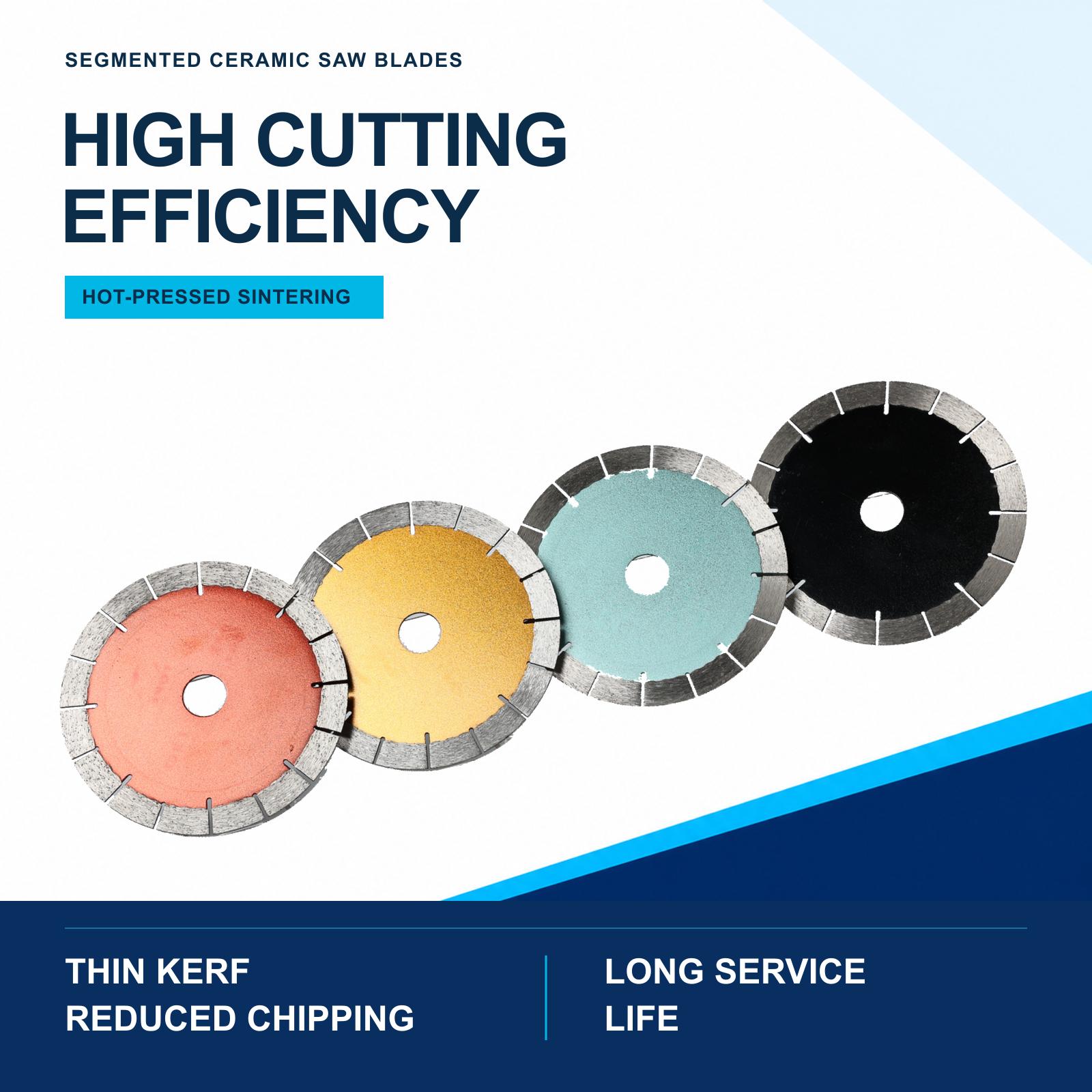
Segmented Ceramic Saw Blades
Start with the tile and machine size. This segmented series covers 120–180 mm; the continuous series covers 200–400 mm. Compare the complete size and intended cutting method before choosing.
View specifications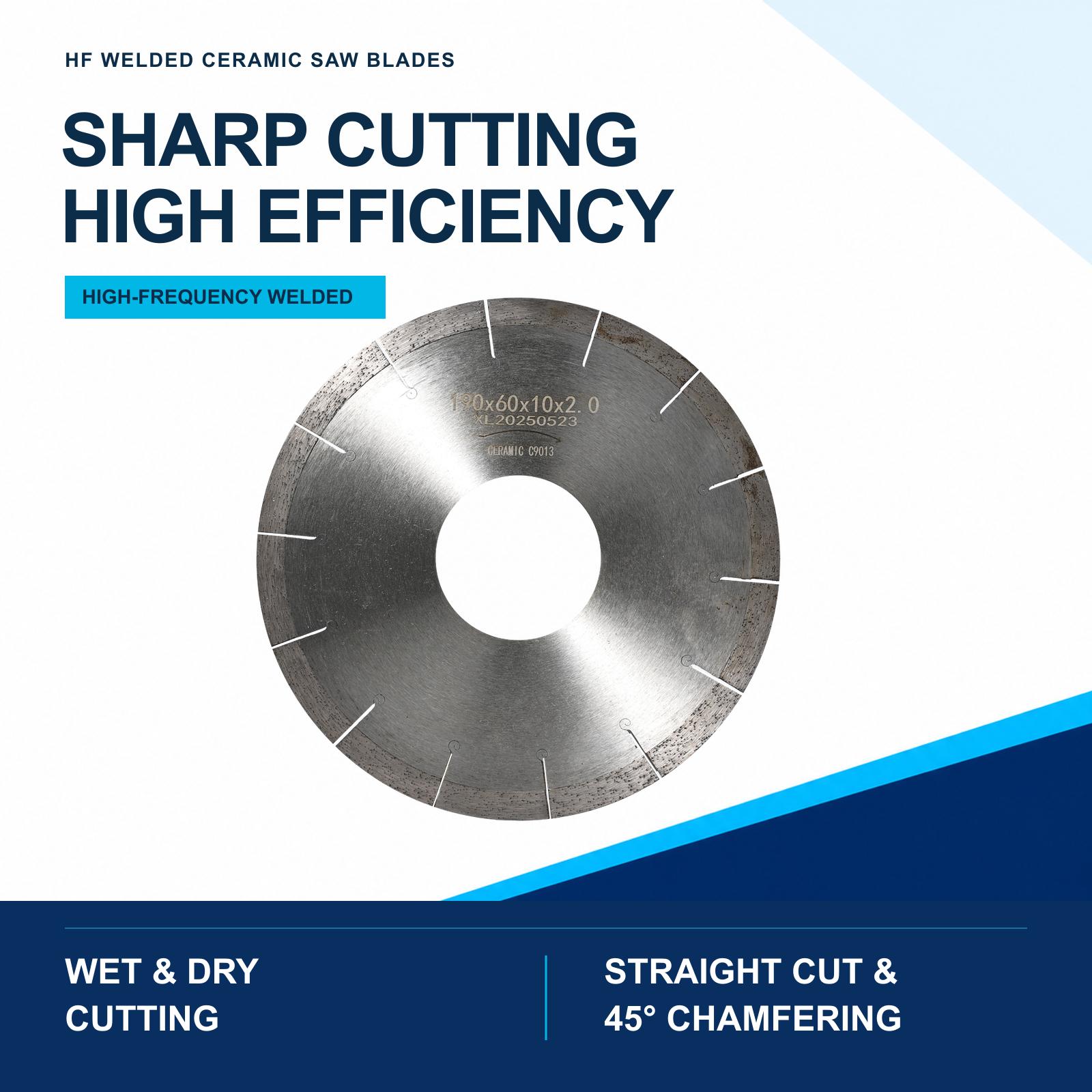
HF Welded Ceramic Saw Blades
Compare this 190–400 mm series for table-type and bridge cutting machines. Match the tile, cut and mounting dimensions; the welding method alone does not determine edge quality or dry-use suitability.
View specificationsNeither a larger diameter nor a different joining process proves a better result on a particular tile. Identify the tile body, glaze, thickness and required edge before discussing which configuration to trial.
Selection example: comparing two supplier quotations
If both quotations offer the same diameter, ask each supplier to complete the remaining fields: bore, segment height and thickness, intended material, operating mode and speed requirements. Clarify whether “HF” identifies brazing or another joining description in that supplier’s terminology.
Put the process label in context
- 01
Material and operation
Name the tile or stone, thickness, cut type and edge requirement.
- 02
Construction and geometry
Compare the bond, core, attachment and actual dimensions together.
- 03
Machine and operating mode
Confirm the mounting, speed range and wet/dry rating for the item.
- 04
Trial and approval
Compare the accepted edge, cutting time and wear under the agreed conditions.
Agree a trial on representative material and inspect the accepted edge before comparing cutting time. Record any dressing, adjustment, rejects and downstream finishing. These observations make the price comparison more useful than selecting by the manufacturing label alone.
What to approve before ordering
Keep one description that identifies the product, dimensions, construction, application and permitted operation. For repeat orders, retain that approved reference and ask the supplier to identify changes to it. An inspection record should address the agreed dimensions and condition as well as the order identity.
FAQ
Is an HF-welded diamond blade the same as a laser-welded blade?
No. HF welding generally refers to a high-frequency induction brazing/joining route, while laser welding uses an industrial laser. Confirm the supplier’s exact process definition.
Is a welded diamond blade always better than a hot-pressed blade?
No. The correct choice depends on material, machine, dimensions, rim/segment design, bond, operating mode and required result. Compare complete configurations.
Can HF-welded diamond blades be used dry?
Only when the exact blade is explicitly rated for dry use and the machine and control system also permit it. Do not infer dry rating from the word “welded.”
What information should I send for a comparison?
Send material, thickness, machine, diameter, bore, flange, speed, wet/dry mode, operation, required edge, current blade and production result.