
THE SHORT ANSWER
Choose for your tile and saw.
Choose by tile body, required edge and machine fit before comparing rim style. A continuous rim is a starting point for an exposed finish; a ceramic-specific segmented blade is another option when its specification matches the job. Confirm diameter, bore, speed rating and cooling, then compare sample cuts on your actual tile.
- Start with the tile. Identify its body and finish.
- Check your saw. Match its blade requirements.
- Try a sample. Inspect the edge before a larger order.
In this guide 8 sections
Compare the rim, then the application
Start with the tile you are cutting and the edge you want to leave. A glazed ceramic wall tile, a dense porcelain floor tile and microcrystalline stone call for different blade choices. Once you know the material, compare rim styles that suit the job.
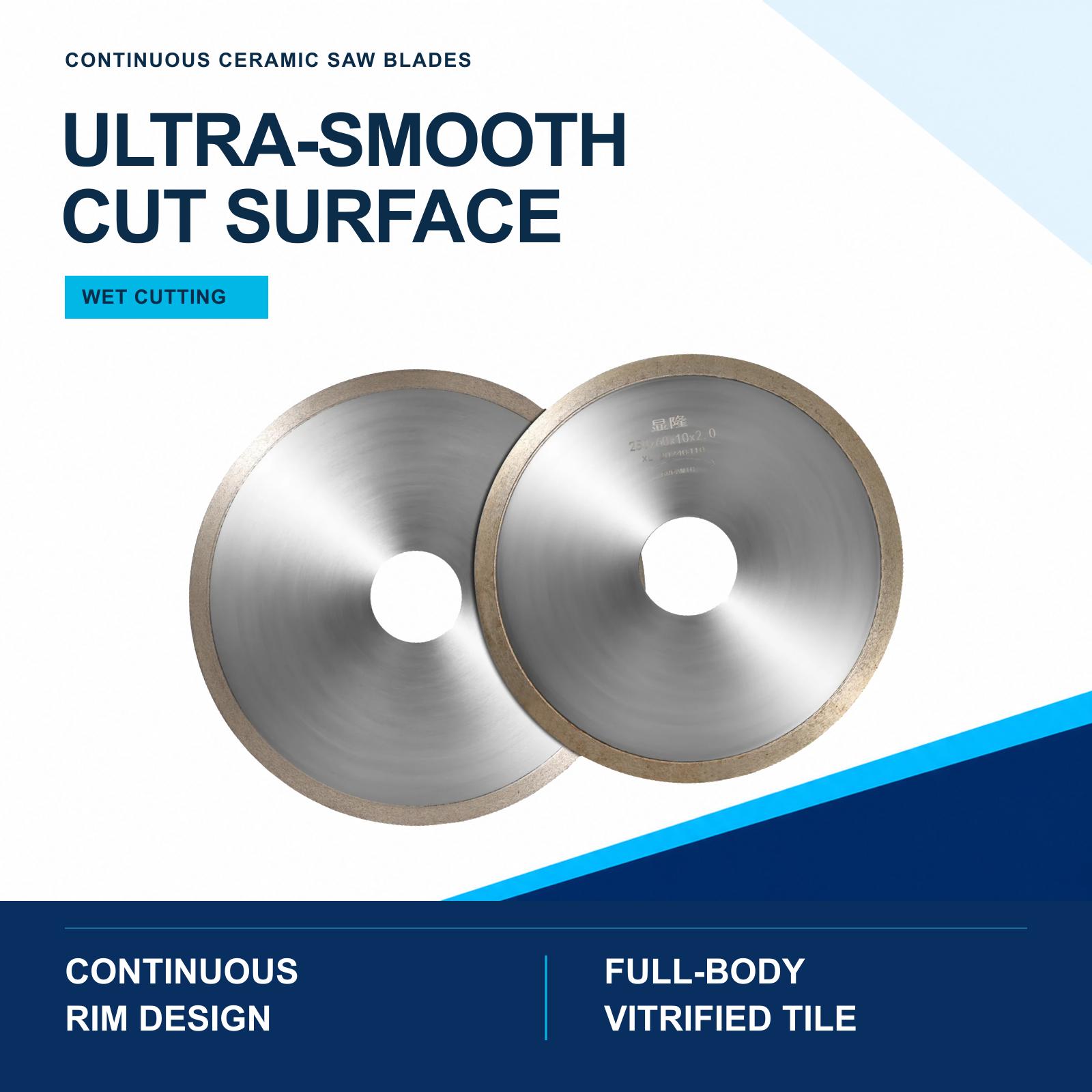
An uninterrupted cutting rim.

Slots separate the cutting segments.
For a visible tile edge, a continuous ceramic blade is a useful starting point. If you are considering a segmented blade, choose one made for the ceramic material you are working with. Check both the machine fit and a sample cut before placing a larger order.
“HF welded” describes how the cutting segments are attached; “continuous” and “segmented” describe the rim layout. When comparing blades, ask about both the construction and intended application. Our hot-pressed vs HF-welded guide explains the process differences.
The diamonds and the bond holding them also affect how a blade cuts and wears. Norton’s explanation of diamond blade construction is useful background when discussing a blade specification with your supplier.
Selection table: when to shortlist each rim
Before requesting a sample, decide what an acceptable edge looks like. Will it be exposed, hidden under trim, or finished in a later operation? Send a close-up photograph with a scale, along with the tile type, thickness and batch. That gives the supplier a clearer target than simply asking for “no chipping”.
| Selection question | Continuous ceramic | Segmented ceramic |
|---|---|---|
| When to shortlist | Consider a continuous rim for exposed tile edges where finish quality matters. Choose a blade suited to your tile and saw. | Consider a ceramic-specific segmented blade when its application and dimensions fit the job. Check a sample cut against the edge finish you need. |
| What the rim changes | The cutting rim runs continuously around the blade, maintaining contact with the tile as it turns. | Gaps separate the cutting segments, helping clear debris and cool the blade during cutting. |
| Applications | Vitrified glazed tiles · Interior wall ceramic tiles · Polished antique tiles · Glazed wall tiles | Polished tiles · Glazed tiles · Antique tiles · Microcrystalline stones |
| Diameters · mm | Φ200 / Φ250 / Φ300 / Φ350 / Φ400 | Φ120 / Φ130 / Φ160 / Φ180 |
| Before confirming a blade | Use this series for wet cutting. Match the bore, speed rating and mounting flanges to your saw. | Match the bore, speed rating and mounting flanges to your saw. Check whether the exact blade is approved for wet or dry use. |
Compare by question Tap to expand
When to shortlist
- Continuous ceramic
- Consider a continuous rim for exposed tile edges where finish quality matters. Choose a blade suited to your tile and saw.
- Segmented ceramic
- Consider a ceramic-specific segmented blade when its application and dimensions fit the job. Check a sample cut against the edge finish you need.
What the rim changes
- Continuous ceramic
- The cutting rim runs continuously around the blade, maintaining contact with the tile as it turns.
- Segmented ceramic
- Gaps separate the cutting segments, helping clear debris and cool the blade during cutting.
Applications
- Continuous ceramic
- Vitrified glazed tiles · Interior wall ceramic tiles · Polished antique tiles · Glazed wall tiles
- Segmented ceramic
- Polished tiles · Glazed tiles · Antique tiles · Microcrystalline stones
Diameters · mm
- Continuous ceramic
- Φ200 / Φ250 / Φ300 / Φ350 / Φ400
- Segmented ceramic
- Φ120 / Φ130 / Φ160 / Φ180
Before confirming a blade
- Continuous ceramic
- Use this series for wet cutting. Match the bore, speed rating and mounting flanges to your saw.
- Segmented ceramic
- Match the bore, speed rating and mounting flanges to your saw. Check whether the exact blade is approved for wet or dry use.
Compare the blades on the same tile batch, with the tile properly supported and the same edge inspection method. Use the recommended settings for each blade and record them. Once you know which cuts meet your finish requirement, compare cutting time and price.
Look at the cost of usable cuts. Count the blade cost, acceptable pieces and any rework together. A cheaper blade can be poor value if more edges need repair or replacement.
Check the machine before ordering
Check the blade diameter, centre bore, mounting arrangement and speed rating against your saw. Keep the four dimensions below separate when you ask for a quotation: outside diameter, bore, segment height and segment thickness. The bore fits the machine arbor; segment height and thickness describe the cutting part of the blade.
Send the supplier your machine model and a photograph of its nameplate. Confirm the blade’s bore, flange requirements, maximum rated speed and wet or dry designation against the machine instructions. Norton’s blade-use guidance covers these mounting and operating checks.
Wet or dry suitability is a separate decision from dust control. Follow the machine and blade instructions, and use the controls required for the work material and process. NIOSH’s silica guidance explains exposure prevention when processing materials containing crystalline silica.
Compare current ceramic blade specifications
Compare the three series below to find the diameter and segment dimensions you need. Open “Size combinations” to see which heights and thicknesses go with each diameter, or visit the product page for full specifications.
Continuous ceramic
For vitrified glazed tiles, interior wall ceramic tiles and glazed wall tiles.
Diameters · mmSize combinations (5)
Process: Sintering
| D | H | T |
|---|---|---|
| Φ200 | 10 | 1.8 / 2.0 / 2.2 |
| Φ250 | 10 | 1.8 / 2.0 / 2.2 |
| Φ300 | 10 | 2.0 / 2.2 |
| Φ350 | 10 | 2.2 / 2.4 / 2.6 |
| Φ400 | 10 | 2.2 / 2.4 / 2.6 |
Segmented ceramic
Segmented ceramic saw blades in 120–180 mm diameters for polished, glazed and antique tiles and microcrystalline stone.
Diameters · mmSize combinations (4)
Process: Sintering
| D | H | T |
|---|---|---|
| Φ120 | 10 | 1.6 / 1.9 |
| Φ130 | 11 | 1.6 / 1.8 |
| Φ160 | 12 | 1.8 / 2.0 |
| Φ180 | 12 | 1.8 / 2.0 |
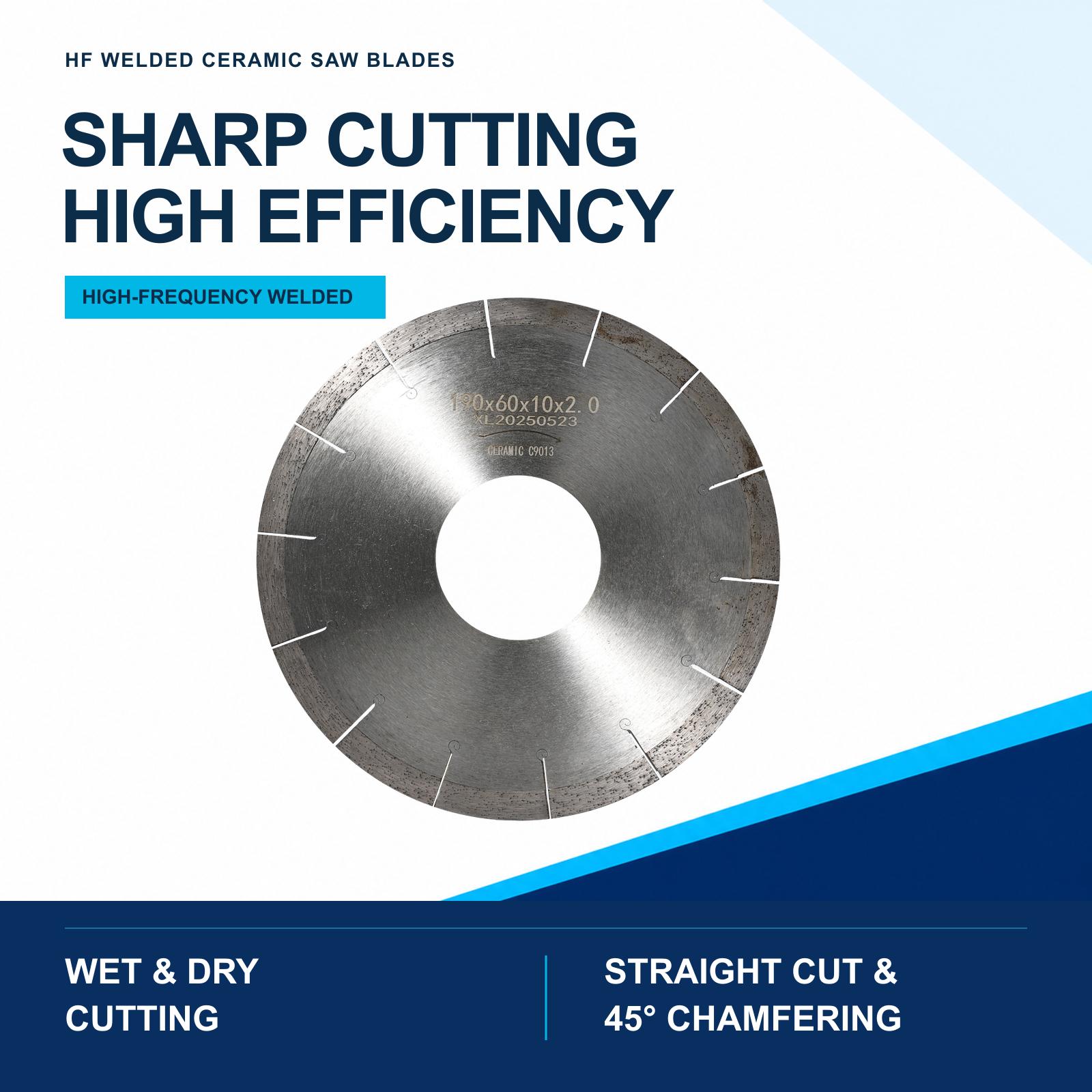
HF-welded ceramic
HF welded ceramic saw blades in 190–400 mm diameters for tile and microcrystalline stone cutting on table-type and bridge machines.
Diameters · mmSize combinations (6)
Process: HF Welding
| D | H | T |
|---|---|---|
| Φ190 | 10 | 1.6 / 1.8 / 2.0 / 2.2 |
| Φ210 | 10 | 1.6 / 1.8 / 2.0 / 2.2 |
| Φ250 | 10 | 1.8 / 2.0 / 2.2 |
| Φ300 | 10 | 1.8 / 2.0 / 2.2 / 2.8 |
| Φ350 | 10 | 1.8 / 2.0 / 2.2 / 2.4 / 2.8 |
| Φ400 | 10 | 2.8 / 3.0 |
Include the required bore and operating speed in your enquiry so the supplier can check the complete fit with your machine.
Worked selection examples
Suppose you need a blade with one of the size combinations below. Start by matching the diameter, segment height and thickness, then use the tile and saw details to narrow the choice.
Choosing a Φ130 mm blade
- Diameter
- Φ130 mm
- Segment height
- 11 mm
- Segment thickness
- 1.8 mm
1 product to consider
For this combination, start with the segmented ceramic series. It offers the required diameter, segment height and thickness; the continuous ceramic series does not include a Φ130 mm option.
Before orderingSend the tile details and saw model with these dimensions so the supplier can check the bore, mounting flanges, speed rating and cooling requirements.
Choosing between two Φ250 mm options
- Diameter
- Φ250 mm
- Segment height
- 10 mm
- Segment thickness
- 2.0 mm
2 products to consider
Both the continuous and HF-welded ceramic series offer this size. To narrow the choice, tell the supplier which tile you are cutting and whether the finished edge will be visible.
Before orderingConfirm that each proposed blade suits your tile and saw, then compare sample cuts against the finish you want.
Prepare a sample trial and enquiry
You will get a more useful recommendation if the supplier understands the job. Include these details in your first enquiry:
- Material: tile type, thickness, face finish and a photograph of the workpiece.
- Machine: manufacturer/model, nameplate, blade diameter, bore, operating speed and cooling arrangement.
- Required result: straight or bevel cut, exposed or concealed edge, and an example of the edge quality you need.
- Purchase context: sample quantity, expected repeat volume and destination.
When you try a sample, record the blade, tile batch, machine settings and cooling method. Photograph the entry edge, exit edge and finished cut under consistent lighting. Keep a note of cutting time, rework and the number of acceptable pieces so you can compare the options before reordering.
If chipping persists, investigate the setup as well as the blade: tile support, blade condition, mounting, cooling and feed all need checking against the equipment instructions. For visible blade movement, consult the wobble and runout troubleshooting guide before continuing a blade comparison.
Questions buyers ask
Is a continuous rim always better for porcelain?
No. It is one option to evaluate for a finished edge, but the blade must also match the tile body, saw and cooling process. Specify the edge requirement and compare an appropriate sample rather than relying on the rim label alone.
Can a segmented blade cut ceramic tile?
A segmented blade designed for the specific ceramic application may be suitable. Our segmented ceramic series lists polished, glazed and antique tiles among its applications. Confirm the actual tile with the supplier; the word “segmented” does not make a general-purpose blade suitable for every tile.
Can I use these blades dry?
Only use a blade dry when that exact blade and the machine are approved for the operation. Confirm the designation, operating instructions and dust controls before ordering. Slots, colour and diameter are not proof of dry-cutting suitability.
Does a thinner segment guarantee a cleaner edge?
No. Thickness is a specification to match to the operation and machine, not an edge-quality guarantee. Use the supplier’s proposed configuration and compare actual cuts against the agreed acceptance criteria.
What if my required diameter or bore is not listed?
Send the machine details and required dimensions for confirmation. A missing size should be treated as a configuration question, not assumed available. The linked product tables show the currently listed options.
Further reading
- Norton: Segmented Versus Continuous Diamond Blades: how rim designs differ.
- Norton: Understanding Diamond Blades: diamond, bond and blade construction.
- Norton: Diamond Blade Do’s & Don’ts: machine compatibility, mounting and wet/dry operating guidance.
- NIOSH: Safe Work Practices for Silica: exposure-prevention guidance for materials containing crystalline silica.